Coronal hole
An opening in the Sun's magnetic field flings charged particles out into space as fast solar wind.
Entender a aurora
A aurora não é magia, mas ao vivo pode parecer. Aqui vai a explicação útil, escrita por quem procura as luzes em campo.
The science
An opening in the Sun's magnetic field flings charged particles out into space as fast solar wind.
Our planet's magnetic field catches those charged particles and steers them along its field lines.
The particles pour down over the north and south poles, striking the air until it glows — the aurora.
Particles hit O₂ + N₂ at ~100 km altitude
Collision releases energy as visible light
Green = O₂ at 100 km · Red = O₂ at 200 km+
Purple and blue tones come from nitrogen
Auroral oval sits at 65°–72°N latitude
Lapland is inside it — cities further south are not
The aurora starts at the Sun. Its corona constantly releases charged particles — mostly electrons and protons — that flow outward as the solar wind. Two features drive the displays we hunt. Coronal holes are openings in the Sun's magnetic field that let high-speed solar wind escape in steady streams; they recur on a roughly 27-day cycle as the Sun rotates. Coronal mass ejections (CMEs) are more violent — the Sun launches a cloud of plasma and magnetic field into space, and an Earth-directed one can set off a major geomagnetic storm. NOAA's Space Weather Prediction Center (spaceweather.gov) tracks both from solar imagery and live solar-wind instruments.
Reaching Earth is not enough — the solar wind has to couple with our magnetic field. That depends on the magnetic field the wind carries, in particular its north–south component, Bz. When Bz points south it links with Earth's magnetosphere and lets particle energy flow toward the poles; the wind's speed and density set how much gets through. The particles, chiefly electrons, accelerate down the field lines and strike oxygen and nitrogen 100–300 km up, and those atoms shed the energy as light.
Colour depends on which gas is struck and at what altitude. Oxygen glows green near 100 km and deep red above about 200 km; nitrogen produces the blue and violet along the lower edges of a strong display. Rovaniemi sits directly beneath the auroral oval — the permanent ring of activity centred on the magnetic pole. That position is why we see the lights on far weaker activity than anywhere further south, on any clear night of the season.

Reading the forecast
The Kp index is a 0–9 scale of average global geomagnetic activity, issued by NOAA (spaceweather.gov) in three-hour blocks. It is a useful broad gauge — whether an evening, or the days ahead, are likely to be active — and nothing more. We never use it to decide whether to run a hunt.
Kp is an average, assigned after the fact, so it misses what happens minute to minute on the ground. A quiet Kp 1 can produce a strong display when a short burst arrives, and a forecast Kp 5 can stay flat all night. Sitting directly under the auroral oval, we regularly see clear aurora at Kp 1–2. Walking out thinking "it's only Kp 1 tonight" would mean missing most of our best nights.
What we actually forecast on is the live solar-wind feed — above all the Bz. When Bz turns sharply south, toward −10 nT or lower, and holds there, energy is entering the magnetosphere and a display usually follows within 20–60 minutes. We watch that data through the night and call the timing to roughly the hour. The other half of the job is cloud: a clear sky over Kp 2 beats overcast over Kp 7 every time, so we drive to find the gap.
Visible from Rovaniemi from as low as Kp 0–1 · Kp 3+ on a clear night is excellent here
Tonight in Rovaniemi

Where to look
About 90% of the time the aurora forms to the north-west, out over northern Sweden and toward Tromsø — which is why so many of our hunts cross the border. Driving 50–100 km in any direction barely changes the view: the lights are hundreds of kilometres away. So we don't chase the aurora's compass point, we chase clear sky. If the only gap in the cloud is to the south, we drive south, and the display looks the same. Only a major solar storm — once or twice a season — pushes the lights far enough south that Helsinki and central Europe catch them too.
Best time to visit
The season runs from late August to early April — you need darkness and clear sky at the same time. Autumn (Aug–Oct) brings strong activity and often clearer skies, but the lakes, rivers and swamps aren't frozen yet, so the places we can safely drive to are limited, and with little snow the landscape — and the photos — look darker. Deep winter brings snow that lights the whole scene. In our experience the best window is late February into March: heavy snow on the ground, fewer clouds, and the strongest displays of the season.
The Kp index hints at solar activity; cloud cover decides whether you see anything. Of the two, cloud is what stops you — a clear Kp 2 night beats a cloudy Kp 7. The moon matters too: around full and half moon the landscape lights up beautifully for photos, but the bright sky lowers aurora contrast, so you need a stronger display to see it well.
The lights show most often between 21:00 and 02:00 local time. Our hunts depart between 16:00 and 22:00 depending on conditions.
The aurora season in Rovaniemi runs from roughly late August to early April — whenever the nights are dark enough. Here is what each part of the season feels like on the ground.
Odds reflect typical darkness and weather — actual sightings always depend on cloud cover and solar activity on the night.
Revontulet
In Finnish the Northern Lights are called revontulet — fox fires. The story goes like this: a great fox runs across the Lapland fells at night, so fast its tail sweeps the snowdrifts into the air. Where the snow catches the stars, fire sparks across the sky.
The Sámi, the Indigenous people of Lapland, held the lights in deep respect — for many groups they were the spirits of the sky, not to be pointed at, whistled at or mocked. Quiet was the rule. The specifics varied between communities, but the lights were never just weather: they meant something. The fox-fire story and the spirit beliefs sit side by side in Lapland to this day.
Today the lights are a forecast and a Kp number and a booking confirmation. They're also still the thing people cry at on tour. Both can be true.
It's the kind of story that makes more sense standing outside at 11pm in January watching green light fold across the sky above the treeline than it does reading it here.

From our hunts
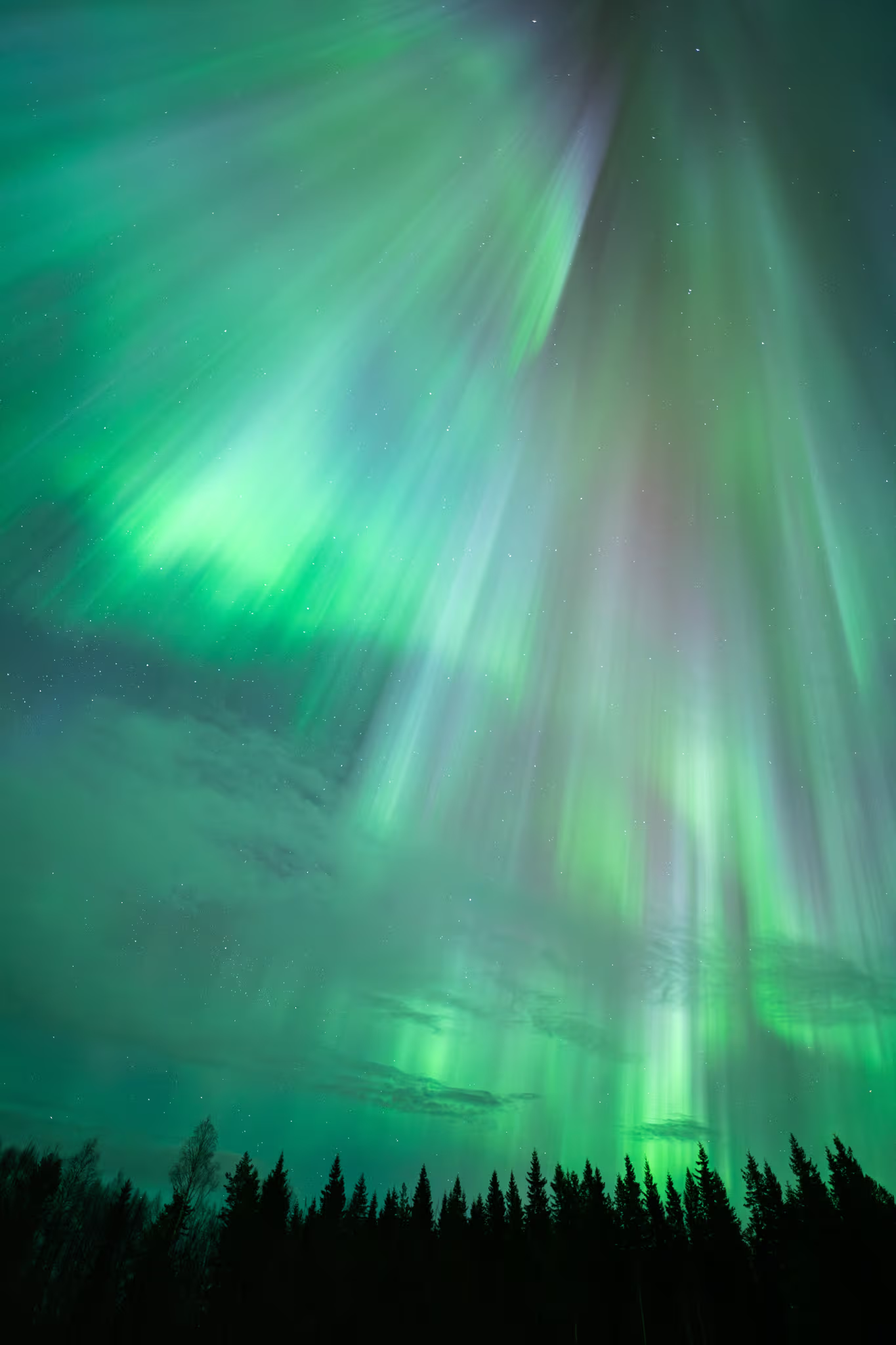
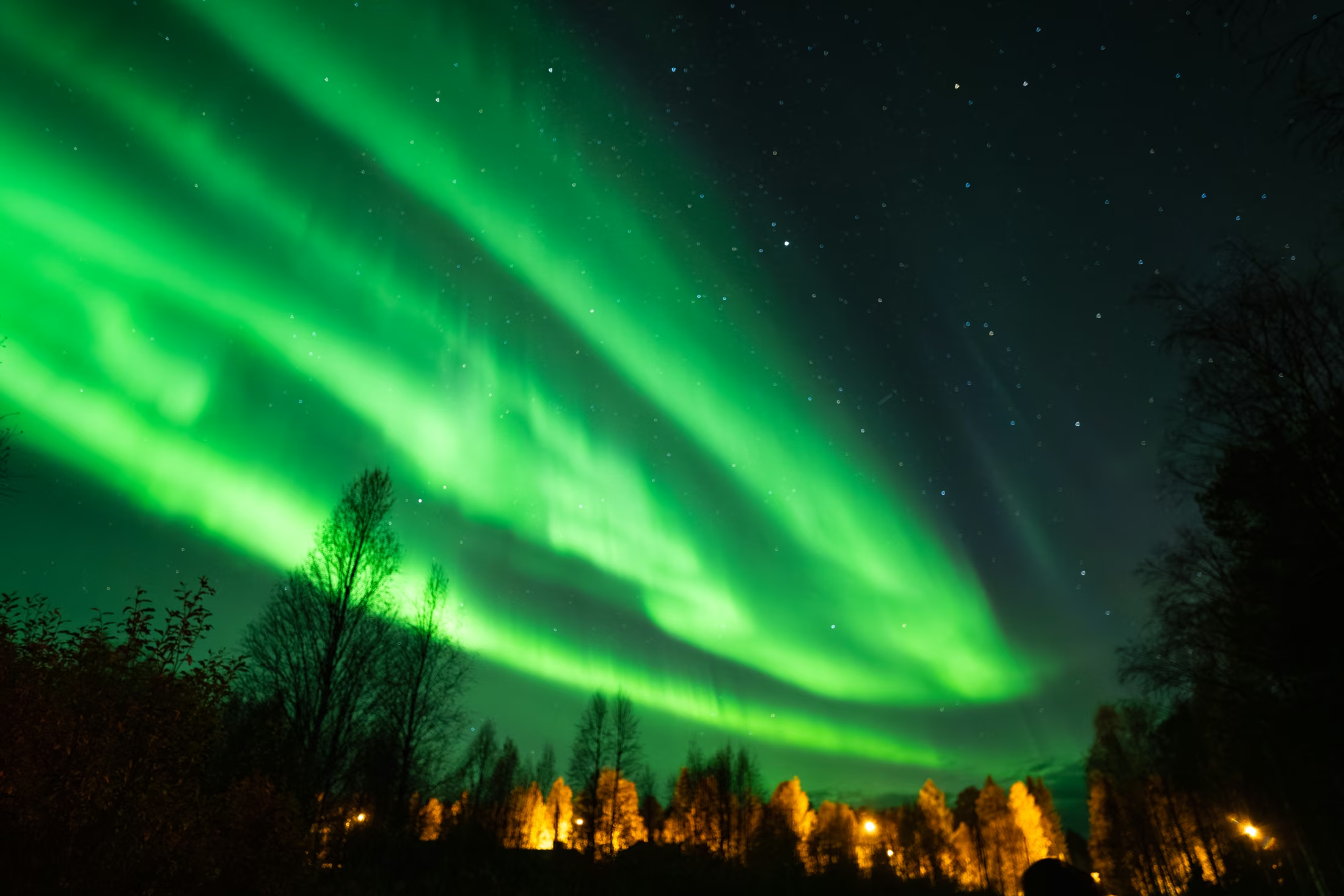
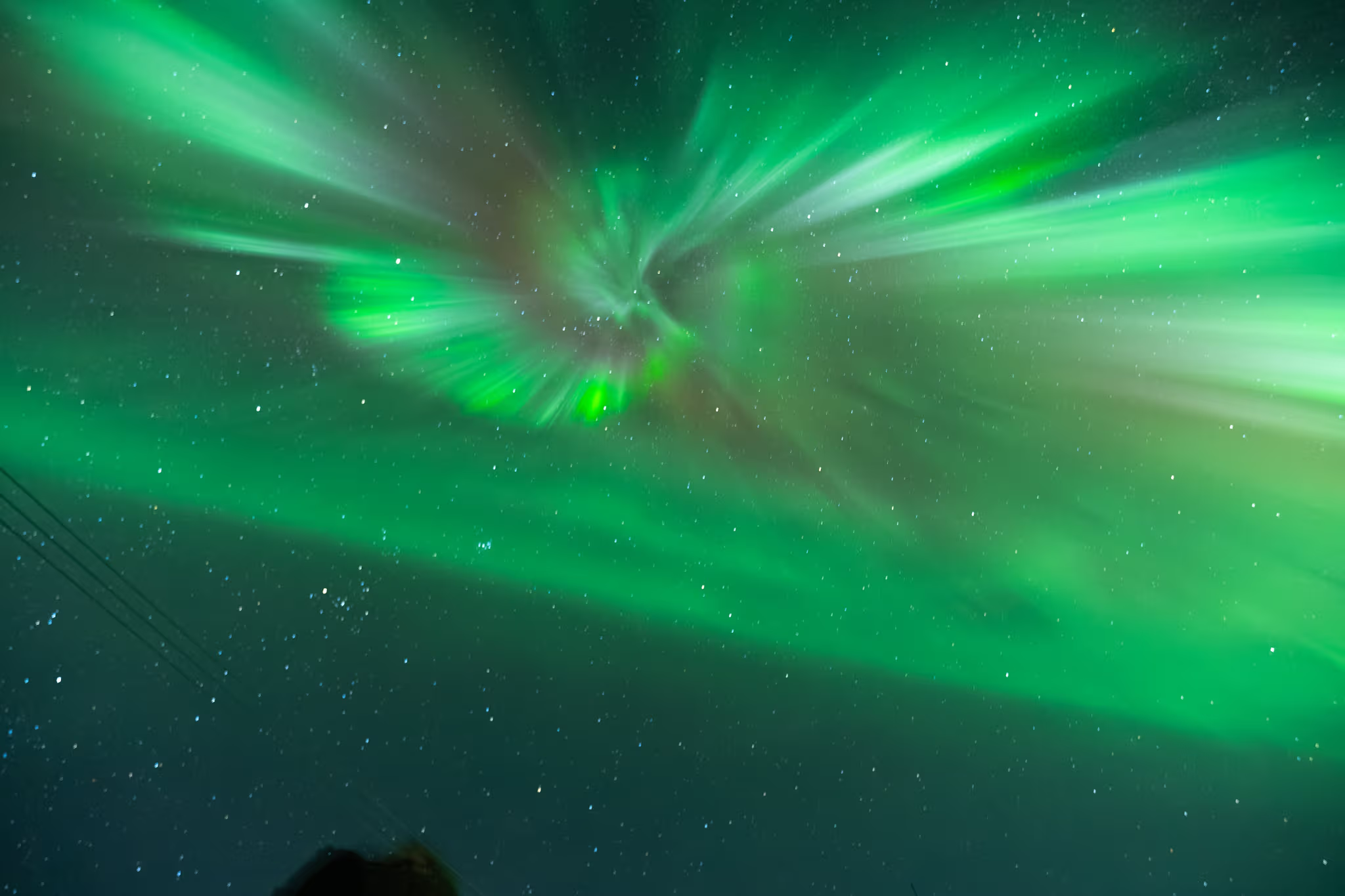
Photos taken by our guides on real hunts. A long camera exposure gathers more light than the eye can, so stills always look more vivid than the moment. A phone or camera video, though, matches what you actually see almost one to one — that is the honest reference for the naked eye.
A phone or camera video like these is the most honest preview of the aurora — it matches what you see with the naked eye far more closely than a long-exposure still.


Why it glows · Interactive
The colour depends on altitude: oxygen glows green low down and red up high, nitrogen adds pink and violet at the edges. Draw your own aurora below — the colour follows the height where you paint.
Photographing the aurora
The aurora is faint and moves fast, so a few manual settings make all the difference. Here are the essentials — the full breakdown of cameras, lenses and technique is in our complete guide.
Recent phones can capture the aurora. Use Night mode — or Pro / Manual mode at a 5–10 second exposure, ISO 800–1600 and focus to infinity. Rest it on something solid and tap the sky to focus.
A tripod is a must-have if you shoot with a DSLR or Mirrorless. No exceptions. Multi-second exposures are impossible to hold steady by hand — even on a phone. A small travel tripod is all you need. You can take decent photos with phones when you hold just by hand, but with tripod you will get always better.
How we hunt
Standing still in one spot and hoping is not a method. Ours is built around data, movement and local knowledge — so on a clear, active night you are under the sky with the best odds in the region. Our guide team of Jesse, Janne, Daniel, Erkka, Jasmin, Aarne, Witold and Jani have developed this approach over years of nightly hunts across Finnish Lapland.
Before every departure we read the SUVI solar imagery for coronal holes and active regions, the live solar-wind feed for speed, density and Bz, and cloud-cover models across the whole region. Bz and cloud decide the night — the Kp is only background.
We work out where the sky will be clearest tonight and plan a route toward it, rather than committing to one fixed viewpoint.
Cloud, not the aurora, is usually what stops people seeing it. We drive as far as it takes to get under clear sky — on some nights that means crossing into Sweden, up to around 380 km round trip.
Small groups, away from city light. Guides set up cameras and read the activity so you know where and when to look.
Professional photos of you under the lights are included — phones rarely capture them well, so we do it for you.
This data-driven approach is also why we can stand behind a money-back guarantee: if we don't see the aurora, you get a full refund.

Our guarantee
Given enough cloudless sky, we would see the aurora on something like 99% of nights — at some point in the darkness, even on the lowest Kp. A fast wide lens on a long exposure pulls the faintest glow out of any dark sky, so a camera-only guarantee would be easy and close to meaningless. We won't do that. Our promise is that you see the northern lights with your own eyes, or your money back. Across two seasons, only a handful of fully clear nights gave us nothing visible — almost always around a full moon.
Questions
Não. Ajuda, mas nuvens e dados ao vivo contam mais durante uma caça real.
Muitas vezes sim, mas o olho pode vê-la mais fraca do que a câmera.
Venha com um guia que entende tanto o céu quanto a estrada.
Entrar numa caça